
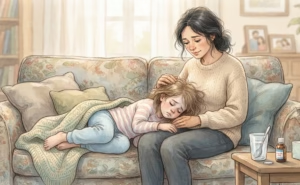
A Personal Story of Emergency Rooms, Daily Injections, Maternal Anxiety, and the Unbreakable Bond of Healing
PROLOGUE: The Silent Fear Every Mother Hides
There is a quiet, terrifying phantom that lives in the back of every mother’s mind. It sits silently in the shadows during the bright, noisy hours of play, waiting for the room to go dark. It is the fear that one day, your child’s body will be gripped by an illness so fierce that your hugs, your warm teas, and your soft lullabies will not be enough to shield them.
In early July, that phantom stepped out of the shadows and walked straight into our home. My four-year-old daughter—my sweet, laughter-filled little girl—began to burn.
ACT I: The Night the World Stopped
It started as a subtle warmth against my cheek as I kissed her goodnight. But within hours, her skin felt like porcelain straight from an oven. Her breathing changed—it wasn’t the slow, rhythmic rise and fall of a sleeping child, but a rapid, shallow, fluttering gasp, like the wings of a trapped bird inside her tiny chest.
By midnight, we were pushing through the heavy revolving glass doors of the pediatric emergency department. The hospital air hit us with its sterile, metallic coldness. My daughter slumped limply against my collarbone, her small hands clutching my shirt, too exhausted even to cry.
Everything after that felt like a movie playing at double speed. The squeak of rubber soles on linoleum. The cold disk of a stethoscope pressed against her back. The sharp prick of a butterfly needle into her delicate vein—a sound of her brief, heartbreaking wail that tore through my soul.
Then came the IV poles. I stared at the clear bags hanging above her bed, reading the labels over and over again until the words blurred before my eyes: 5% Dextrose Ringer’s Lactate, a solution meant to restore her fading energy and electrolyte balance. Below it were pink prescription stickers bearing intimidating names: Iesef 1g (intravenous Ceftriaxone), Feniramin (an antihistamine to calm her system), and Tredison (a potent corticosteroid to reduce the acute swelling in her airways).
And then, the doctor walked in with her bloodwork results.
“Her CRP is 80,” the doctor said, her voice calm, objective, but heavy with gravity.
CRP 80 mg/L. In the pediatric world, where a normal level sits below 5 or 10, a number like 80 is a siren blaring in the dark. It meant an acute, aggressive bacterial fire was burning inside her lower lungs. The diagnosis was official: Pneumonia.
Because the infection was so entrenched, intravenous treatment in the ER was only the first step. We were discharged into the humid July night with a prescription that filled my heart with dread: seven days of daily intramuscular injections—Novosef 750 mg IM—to be administered directly into her tiny thigh muscles every single morning.
ACT II: Seven Days of Needles and White Mist
If you have never had to hold your four-year-old child down while a nurse inserts a thick antibiotic needle into her bared thigh, consider yourself blessed.
Every morning between 10:00 AM and 11:00 AM, a dark cloud of anticipatory grief settled over our living room. My daughter would see the alcohol wipes and begin to plead: “Mommy, please, no more needles today. I’m good, I promise I’m good.” I had to hold her hands, look into her tear-filled eyes, smile warmly, and whisper, “This is the magic medicine that fixes your lungs, my love,” while inside, my own heart was breaking into a thousand jagged pieces.
Our home turned into a mini-respiratory ward. The living room hummed constantly with the sound of the nebulizer machine, churning liquid Ventolin and Cortair into clouds of cool white mist. I sat her on my lap four times a day for Ventolin and twice for Cortair, placing the plastic mask over her small face. She looked like a little astronaut, peering out at me with wide, trusting eyes.
By the third day of injections, a quiet miracle occurred. Her temperature, which had been stubbornly clinging to 37.5°C, dropped down to 36.9°C. The dry, suffocating, spastic cough that shook her whole frame began to change. It became deeper, looser, wetter.
Panicked, I asked myself, “Why is she coughing up so much phlegm now? Is she getting worse?” But I learned the truth: this wet cough was not a sign of defeat—it was the lungs’ broom. The Novosef was killing the bacterial army, and her body was using her cough reflex to physically sweep the dead cellular debris out of her chest.
By day four and five, her spirit returned. Her temperature hovered safely in the subfebrile range of 37.2°C to 37.4°C—the warm signature of an immune system actively cleaning up its battlefield. She started to play again. She threw her head back and laughed, and every time she laughed deeply, a gush of loosened phlegm reached her mouth. Her laughter was doing the work of a chest physiotherapist, shaking loose the sticky mucus from her bronchial walls.
ACT III: Salty Breezes, Tapering Meds, and the Sea
On July 18th, with the 7th and final Novosef injection completed, we stood in our pediatrician’s office for a comprehensive step-down review. Her lungs sounded significantly clearer, but the war was not over—it was shifting from acute elimination to long-term healing and prevention.
Our pediatrician updated her regimen:
- Azitro (Azithromycin syrup): A 5-day course to eradicate any lingering “atypical” intracellular bacteria that cephalosporins like Novosef might have missed.
- Inhaler Transition (Flixotide & Ventolin MDI via Chamber): We retired the loud nebulizer machine and transitioned to handheld metered-dose inhalers paired with a pediatric spacer (AeroChamber). Ventolin 2 puffs every 4 hours while awake, and Flixotide (inhaled corticosteroid) 1 puff twice daily.
- Levmont: Continuing her nightly chewing tablet to block leukotrienes and histamines.
- Broncho-Munal: Planning a 10-day immunostimulant cycle (a oral bacterial lysate “vaccine”) to train her immune memory for the winter ahead.
With this new arsenal, we headed to the seaside for a brief family vacation. The ocean became our natural medicine cabinet. As my daughter swam and splashed in the waves, the natural hypertonic saltwater washed through her nasal passages. It was a miraculous natural rhinowash. Deep, stubborn post-nasal drip that had been sitting in her sinuses for weeks softened and flushed out into the sea. By the end of our first full day at the beach, her daytime cough vanished completely!
ACT IV: Shadows of Doubt – The Ventolin Taper and the Clay-Colored Stool
Yet, a mother’s mind during a medical crisis is a garden where worries grow faster than flowers.
When the time came to taper and discontinue her Ventolin inhaler, intense anxiety gripped me. “The doctor said Ventolin keeps her airways open,” I told myself. “If I stop giving it every 4 hours, won’t her bronchi collapse? What if she wakes up gasping for air in the middle of the night?”
I had to learn the fundamental difference between temporary relief and true healing. Ventolin was like a hand pushing a heavy door open for 4 hours; once the hand lets go, the door swings shut if the hinges are swollen. But Flixotide (the inhaled steroid) and Levmont were the craftsmen repairing the hinges! They eliminated the mucosal swelling so the door stayed wide open naturally.
To test this, we stopped her nighttime Ventolin dose. I lay awake in the dark, listening to her chest, counting her breaths, waiting for the dreaded coughing fit.
It never came. She slept in profound, unbroken silence. Zero nighttime cough. That peaceful silence was the sweetest music I had ever heard.
Then, just as I thought I could catch my breath, a new terror appeared in the bathroom: her stool turned light-colored, pale greyish-white, like sculptor’s clay!
My mind immediately spiraled. Liver failure? Gallbladder obstruction? Hepatitis?
I forced myself to stay calm and systematically check her for red flags:
- Whites of her eyes? Crystal clear white, no yellow jaundice.
- Skin tone? Normal, healthy pink.
- Urine color? Pale yellow, not dark tea or cola.
- Abdominal pain? None. She was jumping on the bed, asking for snacks.
Research and medical reassurance brought the answer: twelve consecutive days of heavy broad-spectrum antibiotics (7 days of IM Novosef followed immediately by 5 days of oral Azitro) had completely wiped out her intestinal microbiome. Normal stool gets its brown color from intestinal bacteria converting bile bilirubin into stercobilin. Without gut bacteria, bile passes through unchanged, leaving the stool pale grey! Additionally, Ceftriaxone is famous for causing transient, harmless “biliary sludge” in the gallbladder.
Within a few days, as her body eliminated the drug residues and her gut flora began to regenerate, her stool returned to its normal, healthy brown color.
ACT V: Steam, School Bells, and the Mystery of the Right Lung
Vacation ended, and we returned home. My daughter proudly put on her backpack and walked into her preschool classroom.
Every morning before breakfast, on an empty stomach, I give her her daily dose of Broncho-Munal. During the first two days, the bacterial lysates triggered a mild, low-grade warmth (37.2°C) and a clear runny nose. I didn’t panic this time—I knew this was the expected “vaccine-like” immune response. Her mucosal B-cells were actively manufacturing secretory IgA antibodies to shield her from preschool germs.
Yesterday evening, after a long day at school, she took a warm bath. As she played with her bath toys, the thick steam filled the room. Suddenly, she sneezed, and a long, whitish-transparent string of mucus slid effortlessly from her nose. It wasn’t thick, yellow, or foul-smelling—it was thin, clear, and hydrated. The bath steam had acted as a natural mucolytic, flushing out the very last pocket of non-infected, clear mucosal secretion. Her nose was left completely clear.
As I sit here tonight watching her sleep peacefully, I reflect on the bigger picture. Over the past 6 months, my four-year-old has suffered through three distinct episodes of pneumonia or severe lower respiratory congestion. And in every single episode, the doctor noted the exact same pattern: “The infection drops rapidly into her RIGHT lung, but resolves miraculously fast with treatment.”
This single observation transformed our perspective. This isn’t a child with a broken, weak immune system. This is a localized, anatomical puzzle!
A rapid-onset, rapid-offset consolidation localized strictly to the right lung points directly to localized phenomena—such as Right Middle Lobe Syndrome (where the narrow right middle bronchus easily gets plugged by temporary allergic mucus) or a forgotten, unnoticed micro-aspiration.
In fifteen days, we have an appointment with a Pediatric Pulmonology Specialist . We will bring a CD containing every single chest X-ray taken since January. We will sit down with the expert, examine her right bronchial anatomy, perform any necessary tests (like a sweat test or immune panel), and craft a definitive, customized protection strategy for the winter ahead.
EPILOGUE: What Healing Really Looks Like
Tonight, as I write these words, there is no fever in our house.
There is no dark, heavy cough echoing down the hallway.
There are no nebulizers humming in the dark, no needles waiting in alcohol wipes, and no clay-colored stools in the bathroom.
My daughter is sleeping peacefully, her chest rising and falling in a slow, effortless rhythm. Tomorrow morning, she will wake up, chew her Levmont tablet, take her Flixotide puff, swallow her Broncho-Munal, and run off to preschool with a laugh that lights up the room.
To every mother reading this who is currently sitting in a cold hospital room, staring at an IV pole, or weeping silently in the bathroom while holding a feverish child: Hold on.
Trust the science, trust your maternal instincts, learn the language of your child’s body, and know that even after the darkest nights and the highest fevers, the morning sun will rise, and your little one will breathe freely once again.
(This story stands as a complete narrative record of our journey, dedicated to every parent seeking hope, clarity, and strength during childhood illness.)