Abstract
Understanding the physiological and cognitive mechanisms governing early human sleep is essential for addressing chronic infant sleep disruption. Drawing exclusively on the evidence-based synthesis presented in Chapter 4 of Precious Little Sleep: The Complete Baby Sleep Guide for Modern Parents (2nd ed.) by Alexis Dubief (2020), this article examines four foundational determinants of infant sleep: sleep architecture (REM and non-REM cycles), dual-process sleep regulation (circadian rhythms and homeostatic sleep drive), cognitive maturation (object permanence), and behavioral conditioning (sleep associations). The review demonstrates how immature sleep cycles interact with emerging cognitive awareness and non-persistent environmental cues to produce frequent nocturnal awakenings, and explains why establishing independent sleep onset at bedtime is central to pediatric sleep consolidation.
Introduction: Why Infant Sleep Differs Fundamentally from Adult Sleep
During the first year of life, infant sleep disruptions are frequently attributed to transient external or physiological factors such as teething, growth spurts, vaccinations, environmental temperature, or wet diapers—though, as Dubief (2020) notes, modern diapers rarely cause nighttime waking unless soiled with stool or leaking. Rather than isolated anomalies, persistent sleep difficulties are best understood through the underlying biology and cognitive development of infancy.
In Precious Little Sleep, Dubief (2020) synthesizes pediatric sleep literature into four core mechanisms that explain how babies sleep and why sleep frequently deteriorates as infants mature: sleep stages and cycles, the biological processes of sleep regulation, object permanence, and sleep associations.
1. Infant Sleep Architecture: REM Cycles and Nocturnal Arousals
Human sleep comprises two primary stages: rapid eye movement (REM) sleep—often termed active sleep—and non-REM sleep. The proportion of time spent in each stage shifts markedly across human development (Dubief, 2020).
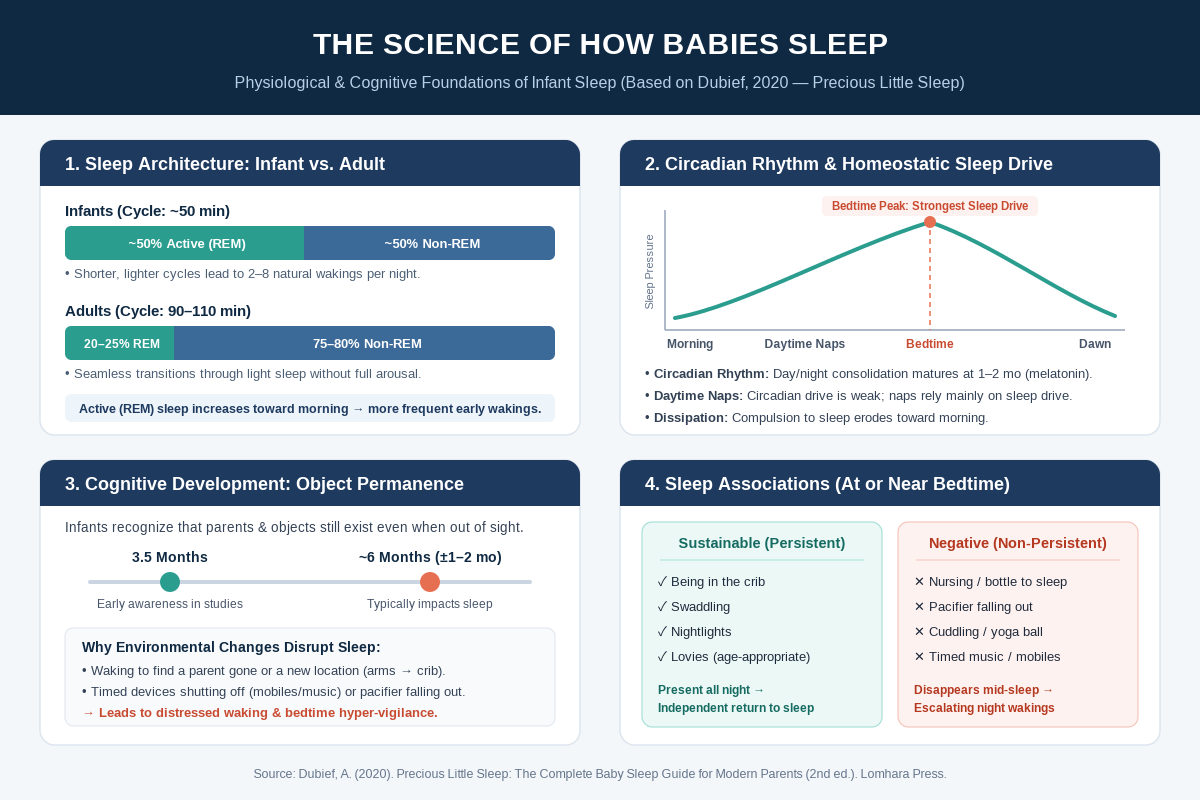
- High Proportion of Active (REM) Sleep: Infants spend approximately 50% of their total sleep time in active (REM) sleep (Anders & Keener, 1985, as cited in Dubief, 2020). By early adulthood, this proportion declines to roughly 20% to 25% (Mindell & Owens, 2003, as cited in Dubief, 2020). Because active sleep is a relatively light phase characterized by motor activity—such as grunting, twitching, and facial movements—infants are naturally noisy sleepers who arouse easily (Dubief, 2020).
- Shortened Sleep Cycles: A complete sleep cycle encompasses both REM and non-REM stages. While adults exhibit a mature sleep cycle lasting approximately 90 to 110 minutes, infants cycle through sleep stages roughly every 50 minutes (Dubief, 2020).
- Natural Nighttime Awakenings: Unlike adults, who typically transition seamlessly through light-sleep phases back into deep sleep without full arousal, infants experience shorter, lighter cycles that generate a natural pattern of waking two to eight times per night (Mindell & Owens, 2003, as cited in Dubief, 2020). Furthermore, because the proportion of active sleep increases toward morning, infants naturally experience more frequent awakenings as the night progresses (Dubief, 2020).
2. The Process of Sleep: Circadian Rhythms and Homeostatic Sleep Drive
As detailed in Precious Little Sleep (Dubief, 2020), sleep timing and continuity are governed by the interaction of two biological systems: the circadian rhythm and the homeostatic sleep drive.
Maturation of the Sleep/Wake Circadian Rhythm
Derived from the Latin term meaning “approximately one day,” circadian rhythms regulate physiological cycles—most notably the sleep/wake cycle that promotes consolidated nocturnal sleep and sustained daytime wakefulness (Dubief, 2020). Infants are born with an immature circadian rhythm, resulting in sleep distributed randomly across the 24-hour cycle during the initial weeks of life; more mature day/night sleep consolidation emerges between 1 and 2 months of age (Rivkees, 2003, as cited in Dubief, 2020). Once a mature circadian rhythm is established and paired with a consistent bedtime, biological mechanisms—including the secretion of the hormone melatonin—regulate themselves to generate a strong compulsion to sleep (Dijk & Czeisler, 1994; Cajochen et al., 2003, as cited in Dubief, 2020).
Homeostatic Sleep Drive
Sleep is further propelled by the homeostatic sleep drive, defined as the physiological pressure to sleep that accumulates the longer an individual remains awake (Borbely & Achermann, 1999; Division of Sleep Medicine, Harvard Medical School, 2007, as cited in Dubief, 2020).
- Bedtime Convergence: Sleep drive accumulates throughout waking hours and peaks just prior to bedtime, where it converges with the circadian rhythm to create the strongest biological compulsion to sleep of the 24-hour day. This explains why an infant’s longest stretch of uninterrupted sleep typically occurs immediately following bedtime (Dubief, 2020).
- Nocturnal Dissipation: As sleep progresses, homeostatic sleep pressure dissipates and grows weaker toward morning. Combined with increasing REM sleep, this diminishing compulsion to sleep causes infants to wake more frequently and struggle to resettle in the early morning hours (Dubief, 2020).
- Daytime Nap Vulnerability: Because the circadian rhythm exerts relatively weak sleep-promoting influence during daytime hours (Dollins et al., 1994; Nováková et al., 2012, as cited in Dubief, 2020), daytime naps are regulated primarily by accumulated sleep drive. Dubief (2020) illustrates this mechanism through a balloon analogy: attempting a nap too early leaves insufficient sleep pressure, waiting too long leads to overtiredness, and even a brief 10-minute accidental nap (such as during a car ride) can prematurely deflate sleep pressure and prevent a subsequent nap.
3. Cognitive Maturation and Sleep Disruption: Object Permanence
A critical developmental milestone affecting infant sleep is object permanence—the cognitive recognition that objects and caregivers continue to exist even when out of immediate sight or physical contact (Dubief, 2020). Closely associated with stranger anxiety and separation anxiety, object permanence was historically believed to emerge around 8 months of age; however, developmental research indicates that infants as young as 3.5 months exhibit awareness of objects removed from view (Baillargeon & DeVos, 1991, as cited in Dubief, 2020). Based on observational experience, Dubief (2020) notes that object permanence typically begins disrupting sleep around 6 months of age (give or take one to two months).
Before developing object permanence, infants operate on an “out of sight, out of mind” basis and can often be rocked, bounced, or nursed fully to sleep and transferred without cognitive distress. Once object permanence emerges, however, any discrepancy between the sleep-onset environment and the waking environment becomes disruptive (Dubief, 2020). Common environmental changes include:
- Absence of a parent who was present at sleep onset;
- Location transfers (e.g., falling asleep in a caregiver’s arms and waking in a crib);
- Timed electronic devices shutting off mid-sleep (e.g., mobiles, musical toys, or timed white-noise machines);
- Dislodged soothing objects (e.g., a pacifier falling out of the mouth).
When an infant arouses during a normal light-sleep transition and detects these environmental changes, they wake fully in distress. Repeated nocturnal “surprises” can also induce bedtime hyper-vigilance, causing infants to resist sleep for extended periods as their biological drive to sleep conflicts with their desire to monitor the caregiver’s presence (Dubief, 2020).
4. Sleep Associations: Sustainable vs. Non-Persistent Cues
Directly linked to object permanence are sleep associations—the specific activities, locations, or objects that occur at or near sleep onset (Dubief, 2020). Crucially, Dubief emphasizes that activities occurring near bedtime can establish robust sleep associations even if the infant is placed in bed awake afterward.
Because infants experience frequent light-sleep arousals, they rely on their sleep associations to transition back into deeper sleep throughout the night. The clinical distinction lies in whether those associations remain persistent across the entire sleep period (Dubief, 2020).
| Category | Mechanism | Examples (Dubief, 2020) | Impact on Night Waking |
|---|---|---|---|
| Sustainable (Persistent) Sleep Associations | Remain present and unchanged throughout the entire night. | Swaddling, nightlights, lovies (when age-appropriate), being in the crib. | Upon normal nocturnal arousal, conditions match sleep onset, enabling independent return to sleep. |
| Negative (Non-Persistent) Sleep Associations | Disappear, stop, or require parental intervention after sleep onset. | Nursing or bottle-feeding to sleep, pacifier falling out, cuddling with a parent, bouncing on a yoga ball, timed music or mobiles. | Upon arousal, the infant cannot resume sleep without recreating the exact bedtime association, resulting in escalating night wakings. |
Clinical Indicators of Failing Sleep Associations
While caregiver-assisted sleep onset (nursing, rocking, patting, cuddling) is developmentally appropriate and effective for newborns under 2 to 3 months, Dubief (2020) identifies clear behavioral indicators that these methods have become unsustainable as the infant matures:
- Persistently Short Naps: Naps remain short or shorten from longer stretches down to 20 to 45 minutes.
- Prolonged Bedtime Resistance: Falling asleep requires escalating time or multiple attempts.
- Transfer Failure: Attempting to lay the infant down before deep sleep results in immediate distress.
- Early-Evening Arousal: Routine waking approximately one hour after bedtime with extreme difficulty resettling.
- Progressive Nocturnal Fragmentation: An initial consolidated sleep stretch followed by progressively more frequent awakenings toward morning.
- Excessively Early Morning Wakings: Wake times shifting progressively earlier.
- Association Rigidity: Flat refusal of any soothing intervention during night wakings other than the specific method used at bedtime (e.g., a nursing-associated infant refusing comfort from a non-nursing parent).
5. Independent Sleep Onset and the “Waiting It Out” Myth
In Precious Little Sleep, Dubief (2020) posits that the inability to fall asleep independently at naps and/or bedtime represents the underlying root cause of virtually all chronic infant and toddler sleep problems (estimating 99.8% of cases).
A common misconception in parenting discourse is that infants will naturally cease waking once they are developmentally “ready.” Dubief (2020) differentiates between legitimate newborn physiology and learned sleep habits: newborns possess tiny stomachs and limited glycogen stores, necessitating frequent nighttime caloric intake alongside their immature sleep/wake cycles. Conversely, when a 6-month-old infant wakes four to eight times per night requiring caregiver intervention to return to sleep, the underlying driver is typically a non-persistent sleep association rather than developmental unreadiness. Waiting passively for spontaneous resolution often perpetuates these fragmented patterns well into toddlerhood—for instance, persisting at 18 months of age (Dubief, 2020).
Because independent sleep is a learned skill rather than an inherent reflex, transitioning an infant away from non-persistent associations at bedtime enables them to navigate natural nocturnal sleep cycles autonomously, frequently resulting in rapid consolidation of nighttime sleep (Dubief, 2020).
Conclusion: Key Scientific Takeaways for Infant Sleep
Synthesizing the physiological and developmental framework outlined by Dubief (2020) in Precious Little Sleep yields several evidence-based principles for understanding infant sleep:
- Nocturnal arousals are biologically normal: Short 50-minute cycles and high proportions of active (REM) sleep cause infants to wake two to eight times per night.
- Timing leverages biology: Aligning a consistent bedtime with a mature circadian rhythm and peak homeostatic sleep drive maximizes the biological compulsion to sleep, whereas daytime naps depend heavily on carefully managed sleep drive.
- Consistency prevents cognitive distress: Following the emergence of object permanence, maintaining identical environmental conditions between sleep onset and mid-night arousals prevents bedtime hyper-vigilance and distressed waking.
- Independent sleep onset is foundational: Replacing non-persistent sleep associations with sustainable, independent sleep cues at bedtime is the primary mechanism for resolving chronic, non-hunger-related night wakings.
References
- Anders, T. F., & Keener, M. (1985). Developmental course of nighttime sleep–wake patterns in full-term and premature infants during the first year of life. Sleep, 8(3), 173–192. (Cited in Dubief, 2020).
- Baillargeon, R., & DeVos, J. (1991). Object permanence in young infants: Further evidence. Child Development, 62(6), 1227–1246. (Cited in Dubief, 2020).
- Borbely, A. A., & Achermann, P. (1999). Sleep homeostasis and models of sleep regulation. Journal of Biological Rhythms, 14(6), 559–568. (Cited in Dubief, 2020).
- Cajochen, C., Kräuchi, K., & Wirz-Justice, A. (2003). Role of melatonin in the regulation of human circadian rhythms and sleep. Journal of Neuroendocrinology, 15(4), 432–437. (Cited in Dubief, 2020).
- Dijk, D. J., & Czeisler, C. A. (1994). Paradoxical timing of the circadian rhythm of sleep propensity serves to consolidate sleep and wakefulness in humans. Neuroscience Letters, 166(1), 63–68. (Cited in Dubief, 2020).
- Division of Sleep Medicine, Harvard Medical School. (2007, December 18). The Drive to Sleep and Our Internal Clock. Healthy Sleep. (Cited in Dubief, 2020).
- Dollins, A. B., Zhdanova, I. V., Wurtman, R. J., Lynch, H. J., & Deng, M. H. (1994). Effect of inducing nocturnal serum melatonin concentrations in daytime on sleep, mood, body temperature, and performance. Proceedings of the National Academy of Sciences, 91(5), 1824–1828. (Cited in Dubief, 2020).
- Dubief, A. (2020). Precious Little Sleep: The Complete Baby Sleep Guide for Modern Parents (2nd ed.). Lomhara Press.
- Mindell, J. A., & Owens, J. A. (2003). A Clinical Guide to Pediatric Sleep: Diagnosis and Management of Sleep Problems. Lippincott Williams & Wilkins. (Cited in Dubief, 2020).
- Nováková, M., Nevšímalová, S., Příhodová, I., Sládek, M., & Sumová, A. (2012). Alteration of the circadian clock in children with Smith–Magenis syndrome. The Journal of Clinical Endocrinology & Metabolism, 97(2), E312–E318. (Cited in Dubief, 2020).
- Rivkees, S. A. (2003). Developing circadian rhythmicity in infants. Pediatrics, 112(2), 373–381. (Cited in Dubief, 2020).